


The Social Security Changes 2026 introduce higher monthly benefits, revised earnings limits, and updated payment schedules for more than 70 million Americans, following the federal government’s annual inflation-linked adjustments. Announced by the Social Security Administration, the changes affect retirees, disabled workers, survivors, and low-income recipients at a time of easing inflation and growing concerns about the program’s long-term financial health.
Table of Contents
Social Security Changes 2026
| Key Fact | 2026 Detail |
|---|---|
| Cost-of-Living Adjustment (COLA) | 2.8% increase in monthly benefits |
| Average Monthly Increase | About $50–$60 for retired workers |
| Taxable Wage Cap | Increased to $184,500 |
| Earnings Limit (Under FRA) | $24,480 annually |
| Earnings Limit (Reaching FRA) | $65,160 annually |
| Full Retirement Age | Remains 67 for those born 1960 or later |
| Medicare Part B Premium | Increased for 2026 |
As inflation stabilizes and demographic pressures intensify, the Social Security Changes 2026 provide modest financial relief while highlighting unresolved questions about the program’s future. For now, beneficiaries face higher payments, updated thresholds, and familiar tradeoffs between income security and rising living costs.
Cost-of-Living Adjustment Raises Benefits in 2026
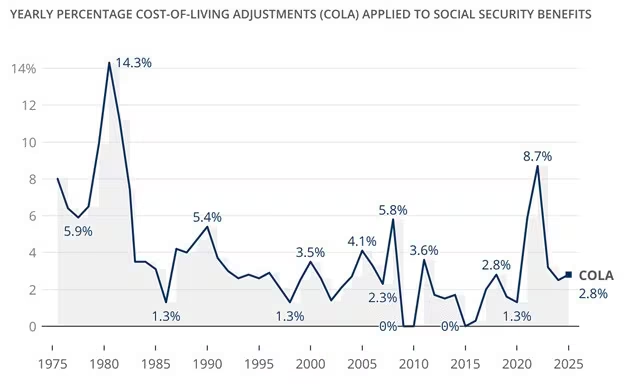
The most visible of the Social Security Changes 2026 is the annual cost-of-living adjustment, known as COLA, which increases benefits beginning in January.
The Social Security Administration announced a 2.8 percent COLA after reviewing consumer price data from the Department of Labor. The adjustment reflects moderating inflation compared with the sharp price increases seen earlier in the decade, while still acknowledging higher living costs for essentials such as food, housing, and medical care.
According to SSA estimates, the average retired worker will receive an additional $50 to $60 per month, though increases vary based on lifetime earnings, claiming age, and benefit category. The COLA applies broadly, covering retirement benefits, Social Security Disability Insurance (SSDI), survivors’ benefits, and Supplemental Security Income (SSI).
SSA officials emphasized that the adjustment is automatic and requires no action from beneficiaries. “The COLA ensures that Social Security benefits maintain their purchasing power over time,” the agency said in a statement.
How Inflation Data Drives the COLA
The COLA is based on the Consumer Price Index for Urban Wage Earners and Clerical Workers (CPI-W), measured during the third quarter of each year. While inflation slowed in 2024 and 2025, prices remain significantly higher than pre-pandemic levels, particularly for healthcare and housing.
Economists note that the CPI-W does not fully capture the spending patterns of retirees, who devote a larger share of income to medical expenses. Some advocacy groups continue to push for alternative inflation measures that better reflect seniors’ costs, though no such changes are included in the Social Security Changes 2026.
Updated Payment Schedule for 2026
The SSA will continue its staggered payment system in 2026, a structure designed to reduce processing bottlenecks and improve reliability.
Retirement, Survivor, and Spousal Benefits
Payments are issued according to the beneficiary’s date of birth:
- 1st–10th: Second Wednesday of each month
- 11th–20th: Third Wednesday
- 21st–31st: Fourth Wednesday
Supplemental Security Income (SSI)
SSI payments are generally issued on the first of the month. When that date falls on a weekend or federal holiday, payments are sent on the previous business day.
SSA officials advise beneficiaries to use direct deposit or the Direct Express card program, noting that paper checks are being phased out under federal payment modernization efforts.
Higher Earnings Limits for Working Beneficiaries
Among the more technical Social Security Changes 2026 are revised earnings thresholds for people who work while collecting benefits.
For beneficiaries below full retirement age, the annual earnings limit rises to $24,480. Earnings above that amount trigger temporary benefit withholding at a rate of $1 for every $2 earned over the limit.
For those reaching full retirement age in 2026, the limit increases to $65,160, with benefits reduced by $1 for every $3 earned above the threshold until the month full retirement age is reached.
The SSA stresses that withheld benefits are not lost permanently. Once a beneficiary reaches full retirement age, monthly payments are recalculated upward to account for previously withheld amounts.
Taxable Wage Cap Increases for High Earners
The Social Security payroll tax applies only to earnings up to a set maximum, known as the taxable wage base. Under the Social Security Changes 2026, that cap rises to $184,500, reflecting overall wage growth.
Workers earning above that amount will see more of their income subject to Social Security taxes, though the tax rate itself remains unchanged. The adjustment increases revenue flowing into the trust funds but does not fully address projected long-term shortfalls.
Policy analysts note that roughly six percent of workers earn above the taxable maximum, making this change most relevant to higher-income households.
Medicare Premiums May Offset Benefit Gains
While gross Social Security payments are rising, many beneficiaries will see part of their increase offset by higher healthcare costs.
The Centers for Medicare and Medicaid Services announced that Medicare Part B premiums will rise in 2026. For most enrollees, these premiums are automatically deducted from Social Security payments, reducing net benefit growth.
Health policy analysts caution that even modest premium increases can strain fixed incomes. “Medical costs remain the single largest expense risk for retirees,” researchers at the Kaiser Family Foundation noted in a recent analysis.
Full Retirement Age and Maximum Benefits Remain Unchanged
The Social Security Changes 2026 do not alter the full retirement age, which remains 67 for individuals born in 1960 or later. Claiming benefits earlier still results in permanently reduced payments, while delaying benefits beyond full retirement age continues to increase monthly checks up to age 70.
The maximum monthly benefit for someone retiring at full retirement age in 2026 exceeds $4,100, according to SSA projections. Those who delay claiming until age 70 may receive more than $5,100 per month, depending on earnings history.
Real-World Impact: Three Beneficiary Scenarios
A Retired Worker:
A 68-year-old retiree receiving $2,000 per month in 2025 would see their benefit rise to about $2,056 in 2026. After Medicare deductions, the net increase may be closer to $30–$40.
A Working Beneficiary:
A 64-year-old part-time worker earning $22,000 annually remains below the earnings limit and experiences no benefit reduction.
An SSI Recipient:
A low-income individual receiving SSI sees their payment rise automatically with the COLA, though housing and food costs may continue to outpace benefit growth.
Long-Term Solvency Concerns Remain
Despite the incremental improvements in 2026, long-term funding challenges persist. According to trustees’ projections, the Social Security trust funds could face depletion in the mid-2030s without legislative action, potentially leading to across-the-board benefit reductions.
Lawmakers remain divided over potential solutions, including raising taxes, adjusting benefits, or modifying eligibility rules. No major structural reforms are included in the Social Security Changes 2026.
What Beneficiaries Should Do Now
The SSA recommends that beneficiaries:
- Review annual benefit statements
- Confirm direct deposit information
- Monitor Medicare deductions
- Track earnings if working while receiving benefits
Most changes take effect automatically, and beneficiaries do not need to file paperwork to receive updated payments.
FAQs About Social Security Changes 2026
Do I need to apply for the 2026 COLA?
No. The adjustment is applied automatically.
Will working permanently reduce my benefits?
No. Withheld benefits are recalculated later into higher payments.
Does the COLA apply to disability and SSI benefits?
Yes. All eligible programs receive the same COLA percentage.
Are taxes on Social Security changing?
No. Tax rules remain unchanged, though more earnings are subject to payroll taxes due to the higher wage cap.